What Goes Into the Mix: How Concrete Composition Determines the Fate of Long-Term Structural Performance
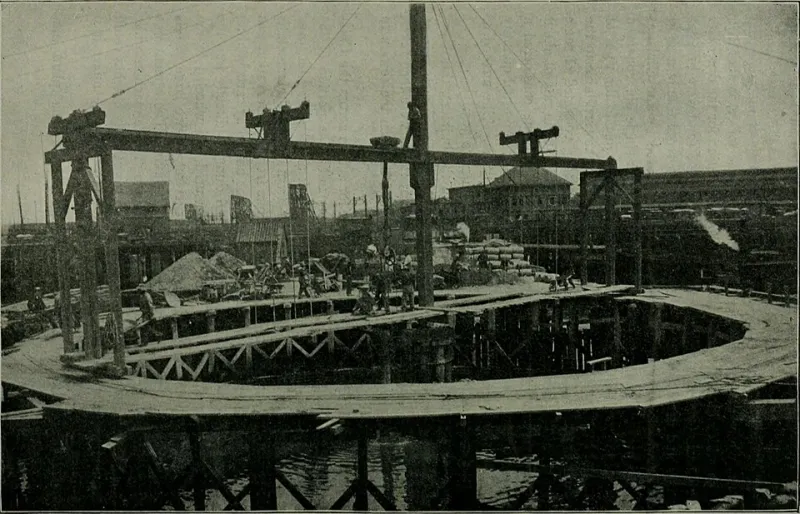
Photo: Internet Archive Book Images, No restrictions, via Wikimedia Commons
Concrete is the most widely used construction material in the United States, yet it is also among the most frequently misunderstood. On a surface level, it appears straightforward — combine cement, water, and aggregate, pour it into a form, and allow it to cure. In practice, however, the chemistry and physics embedded in that process are remarkably complex. The decisions made during mix design are not merely procedural; they are foundational to whether a structure performs as intended for fifty years or begins deteriorating within a decade.
For structural engineers, owners, and developers who invest in the long-term viability of built infrastructure, gaining fluency in the hidden language of concrete composition is not a matter of academic curiosity. It is a professional imperative.
The Aggregate Question: More Than Filler
Aggregate — the sand, gravel, crushed stone, or recycled material that constitutes the bulk of any concrete mix — is often treated as a passive component. It is not. Aggregate gradation, the distribution of particle sizes within a mix, directly influences workability, void content, and ultimately the density and durability of the hardened material.
A well-graded aggregate blend, one that distributes particle sizes across a continuous spectrum, reduces the volume of voids that must be filled by cement paste. Fewer voids translate to a denser matrix, which in turn resists moisture infiltration, freeze-thaw cycling, and chemical attack more effectively than a poorly graded mix. Conversely, a gap-graded aggregate — one with an uneven distribution of particle sizes — creates pathways for water and aggressive ions to penetrate the concrete's interior, accelerating deterioration from the inside out.
Regional geology also plays a decisive role. Aggregate sourced in the arid Southwest carries different mineralogical properties than material quarried in the Great Lakes region or along the Gulf Coast. Alkali-silica reaction, a form of internal chemical expansion that can fracture concrete from within, is directly tied to the reactive silica content of certain aggregate types. Engineers specifying concrete for structures in states like Arizona, Nevada, or parts of Texas must account for these regional material characteristics, selecting aggregates tested for reactivity and pairing them with low-alkali cements or supplementary cementitious materials accordingly.
Water-to-Cement Ratio: The Single Most Consequential Variable
If aggregate selection governs the structural skeleton of a concrete mix, the water-to-cement ratio governs its immune system. This single numerical value — the weight of water divided by the weight of cementitious material in a given mix — exerts more influence over concrete's long-term durability than nearly any other specification.
The relationship is counterintuitive to those unfamiliar with concrete chemistry. More water makes fresh concrete easier to place and finish, which is why contractors have historically been tempted to add water at the job site to improve workability. However, excess water that does not participate in the hydration reaction simply evaporates over time, leaving behind capillary pores. These microscopic channels become conduits for chloride ions, sulfates, and moisture — the primary agents of reinforcement corrosion and chemical degradation.
ACI 318, the governing standard for structural concrete design in the United States, establishes maximum water-to-cement ratios based on exposure conditions. Structures in marine environments, regions with deicing salt exposure, or areas subject to sulfate-rich soils require lower ratios, typically at or below 0.40. Meeting these targets without sacrificing workability is precisely where admixture technology becomes indispensable.
Admixtures: The Precision Instruments of Modern Mix Design
Chemical admixtures have transformed concrete from a blunt instrument into a highly tunable material. High-range water reducers, commonly referred to as superplasticizers, allow engineers to achieve the low water-to-cement ratios demanded by durability standards while maintaining the flowability necessary for complex formwork and congested reinforcement layouts. This is not a minor convenience — it is a structural performance enabler.
Beyond workability, admixtures address a range of durability challenges specific to American climatic conditions. Air-entraining agents introduce a network of microscopic air bubbles into the concrete matrix, providing relief channels for the hydraulic pressure generated when water freezes and expands. For structures in the upper Midwest, New England, or mountainous regions of the West, air entrainment is not optional. It is the difference between a parking structure that survives thirty winters and one that begins spalling within five.
Corrosion-inhibiting admixtures, both calcium nitrite-based and organic formulations, have gained significant traction in bridge and parking structure applications where chloride exposure from deicing salts is unavoidable. These compounds either passivate the steel reinforcement surface or compete with chloride ions at the steel interface, delaying the onset of corrosion-induced cracking and extending service life in ways that surface treatments alone cannot match.
Supplementary cementitious materials — fly ash, slag cement, and silica fume — occupy a category of their own. These byproducts of industrial processes replace a portion of Portland cement in the mix, altering the hydration chemistry in ways that refine the pore structure, reduce permeability, and in many cases improve long-term strength gain. Silica fume, in particular, produces a concrete so dense that it has become the material of choice for high-performance bridge decks and marine infrastructure across the country.
Climate, Exposure, and the Geography of Concrete Specification
No concrete specification exists in isolation from its geographic context. A mix designed for a warehouse in Phoenix will not serve the same structure if it were relocated to Minneapolis or coastal Miami. American climates impose radically different demands on structural concrete, and mix design must reflect that reality.
In freeze-thaw environments, the combination of low water-to-cement ratio, adequate air entrainment, and a durable aggregate becomes the baseline for acceptable performance. In sulfate-rich soils common to parts of the Mountain West and High Plains, Type V or blended cements resistant to sulfate attack are the appropriate specification, not merely a conservative one. Along coastal zones from the Carolinas to the Pacific Northwest, chloride penetration resistance governs the design, directing engineers toward low-permeability mixes with supplementary cementitious materials and, in critical applications, epoxy-coated or stainless steel reinforcement.
The failure to align concrete specifications with exposure conditions is one of the most preventable causes of premature structural deterioration in American infrastructure. It is also one of the most common.
Precision at the Mix Stage Pays Dividends Across the Structure's Life
The cost differential between a standard concrete mix and one optimized for durability is, in most cases, modest. The cost differential between a structure that performs reliably for its intended service life and one that requires significant remediation within fifteen years is not. Concrete repair and rehabilitation represent a substantial and growing expenditure in the United States, much of which traces back to specification decisions made before the first truck arrived on site.
At ADD Structures, the concrete mix design process is treated as a structural engineering discipline in its own right — one that demands the same analytical rigor applied to load calculations and connection design. The materials that fill a form are not incidental to the structure's performance. They are its performance. Getting the mix right from the outset is not overcaution. It is engineering done properly.