Engineering Against Uncertainty: Rethinking Infrastructure Design in the Age of Extreme Weather
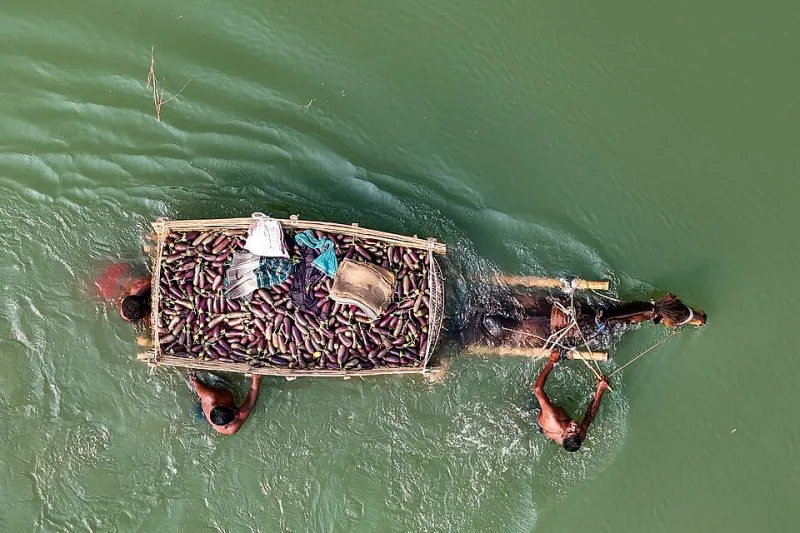
Photo: Ayman Nakib Badhan, CC BY-SA 4.0, via Wikimedia Commons
A Design Standard Built for Yesterday's Climate
America's infrastructure design codes are, by nature, backward-looking instruments. They are built on historical data—decades of weather records, load observations, and material performance studies—that inform the probabilistic assumptions engineers use to establish safety margins. A bridge is designed to withstand a 100-year flood event. A coastal structure is engineered against a wind speed with a two percent annual probability of exceedance. A highway pavement is specified to endure a defined range of freeze-thaw cycles per year.
Those assumptions are now under significant strain. What was statistically defined as a 100-year flood event in parts of the Mississippi River basin, the Carolinas, and the Gulf Coast has recurred within years—sometimes within months—of prior events. The polar vortex disruptions that drove temperatures in Texas to historic lows in February 2021 exposed infrastructure systems designed with entirely different thermal parameters in mind. Wildfire smoke and extreme heat are degrading structural materials in ways that legacy specifications did not account for.
The structural engineering profession is responding—but the conversation is more urgent, and more contested, than it may appear from the outside.
The Limits of Probabilistic Design in a Non-Stationary Climate
Traditional structural engineering relies heavily on probabilistic risk frameworks. The notion of a "design event"—a storm of a certain intensity, a seismic occurrence of a defined magnitude, a thermal range within established bounds—gives engineers a defensible basis for selecting loads and safety factors. These frameworks work well when the underlying statistical distributions are stable over time.
The challenge today is that climate scientists have introduced the concept of non-stationarity into the conversation: the idea that historical data may no longer be a reliable predictor of future conditions. Rainfall intensity is increasing in many regions. Sea levels are rising along virtually every coastal jurisdiction in the United States. Permafrost thaw is altering the bearing conditions for infrastructure in Alaska. The statistical distributions that underpin design standards are shifting, and they are shifting faster than the code-development cycle can comfortably accommodate.
For structural engineers, this creates a genuine professional dilemma. Designing to existing codes is legally defensible and economically expected by clients. Designing beyond existing codes—anticipating conditions that codes have not yet formalized—requires explicit owner buy-in, elevated budgets, and a willingness to justify decisions that may not yet have regulatory backing. The firms and engineers navigating this tension most effectively are those that have developed clear frameworks for communicating climate risk to owners and stakeholders, translating scientific uncertainty into engineering decisions that clients can evaluate and authorize.
Rethinking Safety Factors and Design Margins
One of the most direct responses to climate uncertainty in structural engineering practice is the deliberate adjustment of safety factors and design margins beyond minimum code requirements. This is not a new concept—engineers have long applied judgment in selecting design parameters—but it is gaining renewed attention as a formal strategy rather than an informal one.
For flood-vulnerable infrastructure, some engineers and owners are now designing to the 500-year flood event rather than the 100-year standard, or explicitly adding freeboard beyond what FEMA floodplain maps require. For coastal structures, wind load design is increasingly incorporating projected future hurricane intensification rather than relying solely on historical frequency data. In regions experiencing accelerated freeze-thaw cycling, material specifications for bridge decks and retaining walls are being upgraded to higher durability concrete mixes and more robust joint systems.
These decisions carry real cost implications. Designing a bridge to a higher flood standard may add three to eight percent to the structural cost of the crossing. Specifying higher-performance concrete for a coastal seawall may increase material costs by fifteen percent or more. The critical question for owners and engineers alike is not whether these upgrades cost more—they do—but whether they cost less than the alternative: premature failure, emergency repair, and the disruption costs that cascade through communities when critical infrastructure goes offline.
The evidence from recent infrastructure failures suggests the answer is unambiguous. The economic damage from Hurricane Harvey's flooding of Houston's infrastructure systems, the cascading power and water failures during the 2021 Texas winter storm, and the repeated closure of coastal highways from nuisance flooding in cities like Miami and Norfolk all point toward the same conclusion: the cost of resilience, paid upfront, is substantially lower than the cost of recovery paid after the fact.
Material Selection as a Resilience Strategy
Beyond safety factor adjustments, resilience-driven design is influencing material selection in meaningful ways. High-performance concrete mixes with enhanced sulfate and chloride resistance are becoming standard specifications for infrastructure in coastal and marine environments. Weathering steel, when properly detailed, offers long-term corrosion resistance that reduces lifecycle maintenance costs in humid and industrial environments. Fiber-reinforced polymer composites are being deployed in bridge decking and structural rehabilitation applications where corrosion from deicing salts has historically driven rapid deterioration.
Thermal performance is also emerging as a structural consideration in ways that were previously confined to building envelope design. Extreme heat events are accelerating the expansion and contraction cycles that stress bridge expansion joints, pavement joints, and structural connections. Engineers are revisiting joint spacing and detailing standards for long-span structures in regions where temperature ranges are increasing beyond historical norms.
What Resilience-First Design Means for Project Delivery
The shift toward resilience-first design philosophy does not come without friction in the project delivery process. Owners accustomed to minimum-code compliance as the baseline for infrastructure investment must be engaged in a more substantive conversation about lifecycle value, risk tolerance, and the true cost of underinvestment. Engineers must be prepared to present resilience upgrades not as optional enhancements but as rational economic decisions supported by risk analysis.
Schedule implications are real as well. More comprehensive site investigation, additional design iterations to evaluate resilience scenarios, and extended materials procurement for specialty products all add time to project timelines. Managing these impacts requires early and transparent communication between engineering teams and project owners—a discipline that separates firms capable of delivering resilient infrastructure from those simply executing to minimum standards.
The structural engineering profession is at an inflection point. The tools, materials, and analytical methods to design genuinely resilient infrastructure exist today. What is required now is the professional commitment to apply them consistently, the client relationships to support informed investment decisions, and the design culture that treats long-term performance as the true measure of engineering success. At ADD Structures, that commitment is not a trend we are observing from a distance—it is the standard against which every project we deliver is measured.